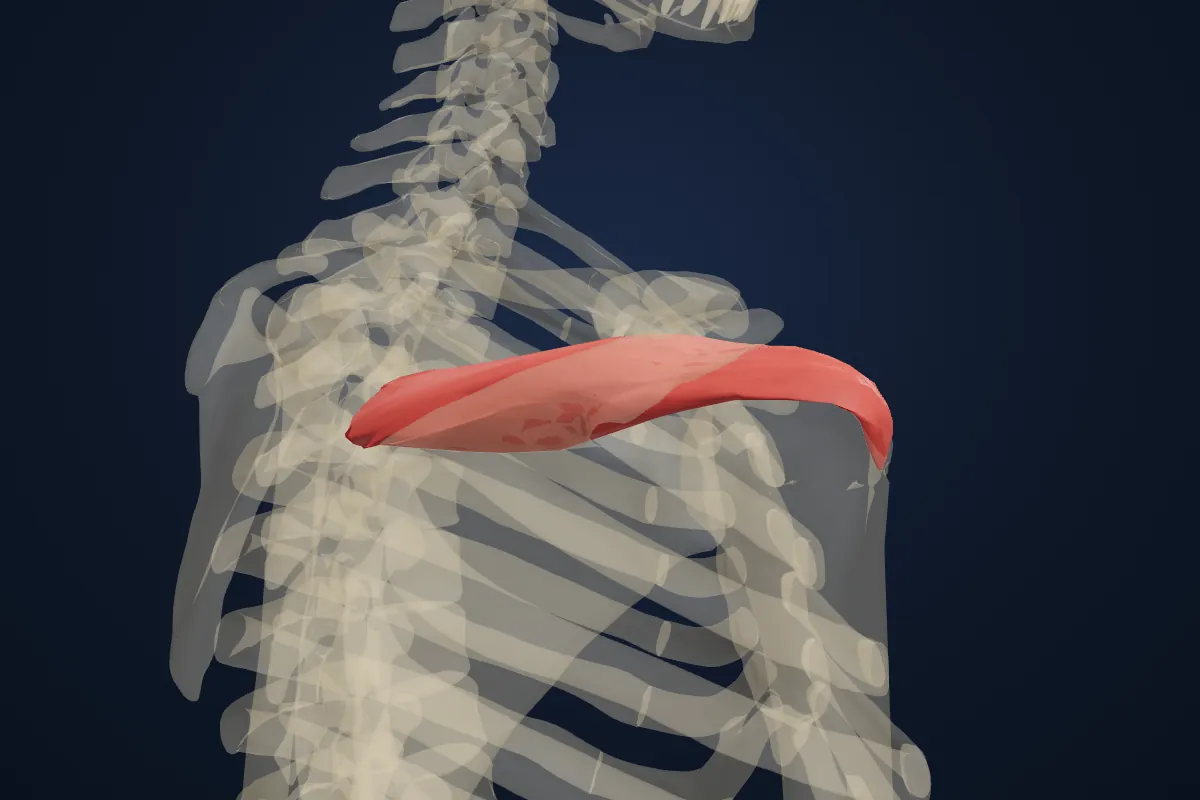
Origin
- Supraspinous fossa of the scapula.
Insertion
- Superior facet of the greater tubercle of the humerus.
Innervation
- Nerve: Suprascapular nerve
- Nerve roots: C5–C6 Sources differ: Segmental (root) levels differ slightly between textbooks; the commonly cited levels are shown. Some sources include C4.
Actions
- Abducts the arm at the glenohumeral joint, acting with deltoid.
- Stabilises the humeral head in the glenoid cavity (as part of the rotator cuff).
Secondary actions
- Traditionally taught as initiating the first ~15° of abduction. This is a teaching convention: supraspinatus and deltoid are both active from the start of abduction and work together throughout the movement. Sources differ: Electromyographic evidence (Reed et al., 2013) shows supraspinatus is recruited before the arm moves but not earlier than deltoid; the "initiator" description is a simplification.
Synergists and antagonists
- Synergists: Deltoid muscle, Infraspinatus muscle, Teres minor muscle, Subscapularis muscle
- Antagonists: Latissimus dorsi muscle, Teres major muscle, Pectoralis major muscle
Relations
- Its tendon passes beneath the acromion and coracoacromial arch, separated from them by the subacromial (subdeltoid) bursa.
Exercises that load this muscle
- Scaption (full can) raise: Thumbs up, raise the straight arms in the plane of the scapula (about 30° forward of the side) to shoulder height and lower slowly.
- Side-lying abduction: Lying on one side, lift the top arm a short range away from the body and lower slowly.
Associated injuries and conditions
Injuries: partial-thickness rotator cuff tear; full-thickness rotator cuff tear.
Conditions: rotator cuff (supraspinatus) tendinopathy; subacromial pain (a clinical presentation that may involve the cuff tendons and subacromial bursa).
See them in 3D:
MSK Map can also show a grade 1, 2 or 3 strain of this muscle in the app.
Related structures
- Infraspinatus muscle – Rotator cuff
- Teres minor muscle – Rotator cuff
- Subscapularis muscle – Rotator cuff
- Suprascapular nerve – Nerve supply
- Subacromial–subdeltoid bursa – Lies above its tendon
- Humerus – Inserts on the greater tubercle
References
- Standring S (ed). Gray’s Anatomy: The Anatomical Basis of Clinical Practice. 42nd ed. Elsevier; 2020. Section 7: Pectoral girdle and upper limb
- Moore KL, Dalley AF, Agur AMR. Clinically Oriented Anatomy. 9th ed. Wolters Kluwer; 2023. Chapter 6: Upper limb
- Betts JG, et al. Anatomy and Physiology 2e. OpenStax; 2022. CC BY 4.0. 11.5 Muscles of the pectoral girdle and upper limbs (tables) Link
- Reed D, Cathers I, Halaki M, Ginn KA. Does supraspinatus initiate shoulder abduction? J Electromyogr Kinesiol. 2013;23(2):425–429. Supraspinatus recruitment in abduction
Clinically reviewed and signed off by Arun Gray BSc MSc MSST on 21 November 2026.