An illustrative model built on the reference anatomy. It does not show any individual patient’s tissue and does not establish a diagnosis.
In plain English
The supraspinatus tendon runs over the top of the shoulder and helps lift the arm. In tendinopathy the tendon becomes painful and less able to cope with load, often after an increase in activity or with age. It usually causes pain when lifting the arm out to the side or overhead. It is not usually a tear, and exercise-based rehabilitation is a common first treatment.
What the visualisation shows
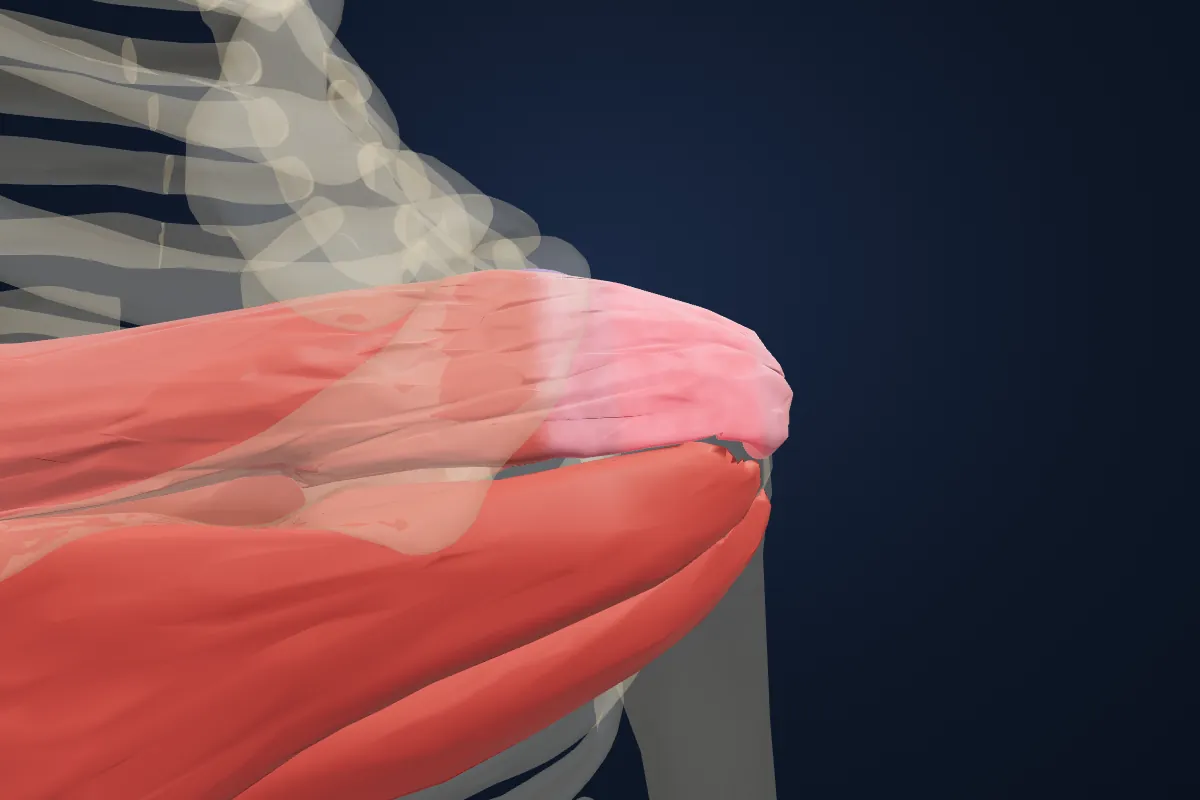
- Typical appearance Thickening of the tendon near its insertion on the humerus, a common imaging finding in tendinopathy.
- Illustrative convention Degenerative change: the normally parallel collagen fibres become disorganised and the tendon loses its glossy appearance. Shown as dull, mottled tissue (a visual convention for changes seen under the microscope).
- Variable finding Red glow: increased blood flow from new small blood vessels growing into the tendon (neovascularisation), often with nerve ingrowth. Seen on Doppler ultrasound in many painful tendons, but not all, and also in some pain-free ones.
Clinical notes
- A painful condition of the supraspinatus tendon with impaired load tolerance, most often affecting the tendon close to its insertion on the greater tubercle.
- Histology typically shows a degenerative (tendinosis-type) picture rather than classic inflammation, although the role of inflammation is still debated.
- Imaging may show tendon thickening and altered signal; findings correlate imperfectly with symptoms and are common in people without pain.
Mechanism
- Multifactorial: changes in load, age-related tendon changes and individual factors. Extrinsic compression ("impingement") is now considered one possible contributor rather than the sole cause.
Structures involved
References
- Standring S (ed). Gray’s Anatomy: The Anatomical Basis of Clinical Practice. 42nd ed. Elsevier; 2020. Section 7: Pectoral girdle and upper limb
- Moore KL, Dalley AF, Agur AMR. Clinically Oriented Anatomy. 9th ed. Wolters Kluwer; 2023. Chapter 6: Upper limb
Clinically reviewed and signed off by Arun Gray BSc MSc MSST on 21 November 2026.