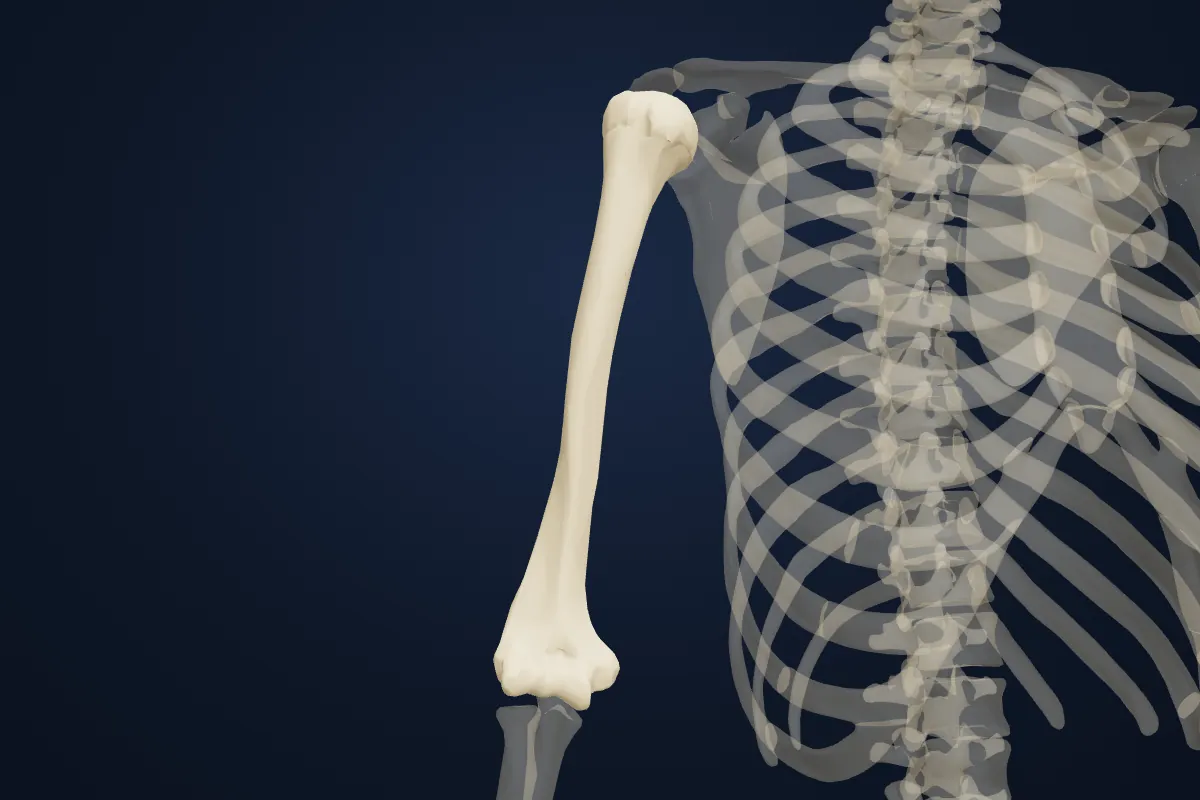
Landmarks
- Head, anatomical neck and surgical neck; greater and lesser tubercles with the intertubercular (bicipital) groove.
- Deltoid tuberosity and radial (spiral) groove on the shaft.
- Distally: medial and lateral epicondyles, capitulum, trochlea, and the olecranon, coronoid and radial fossae.
Articulations
- Glenoid of the scapula (shoulder).
- Ulna (trochlea) and radius (capitulum) at the elbow.
Attachments
- Rotator cuff to the tubercles; pectoralis major, latissimus dorsi and teres major around the bicipital groove; deltoid to the deltoid tuberosity.
- Common flexor origin (medial epicondyle) and common extensor origin (lateral epicondyle).
Clinical relevance
- Proximal humerus fractures (surgical neck) are common fragility fractures; the axillary nerve lies close by.
- Shaft fractures can injure the radial nerve in the spiral groove.
- Supracondylar fractures in children can injure the brachial artery and median nerve.
Associated injuries and conditions
Injuries: proximal humerus fracture; humeral shaft fracture; supracondylar fracture (children); shoulder dislocation.
Conditions: lateral and medial elbow tendinopathy (epicondyles).
See them in 3D:
Related structures
- Axillary nerve – Winds around the surgical neck
- Radial nerve – Runs in the spiral groove
- Scapula – Forms the shoulder joint with it
References
- Standring S (ed). Gray’s Anatomy: The Anatomical Basis of Clinical Practice. 42nd ed. Elsevier; 2020. Section 7: Pectoral girdle and upper limb
- Moore KL, Dalley AF, Agur AMR. Clinically Oriented Anatomy. 9th ed. Wolters Kluwer; 2023. Chapter 6: Upper limb
Clinically reviewed and signed off by Arun Gray BSc MSc MSST on 23 November 2026.