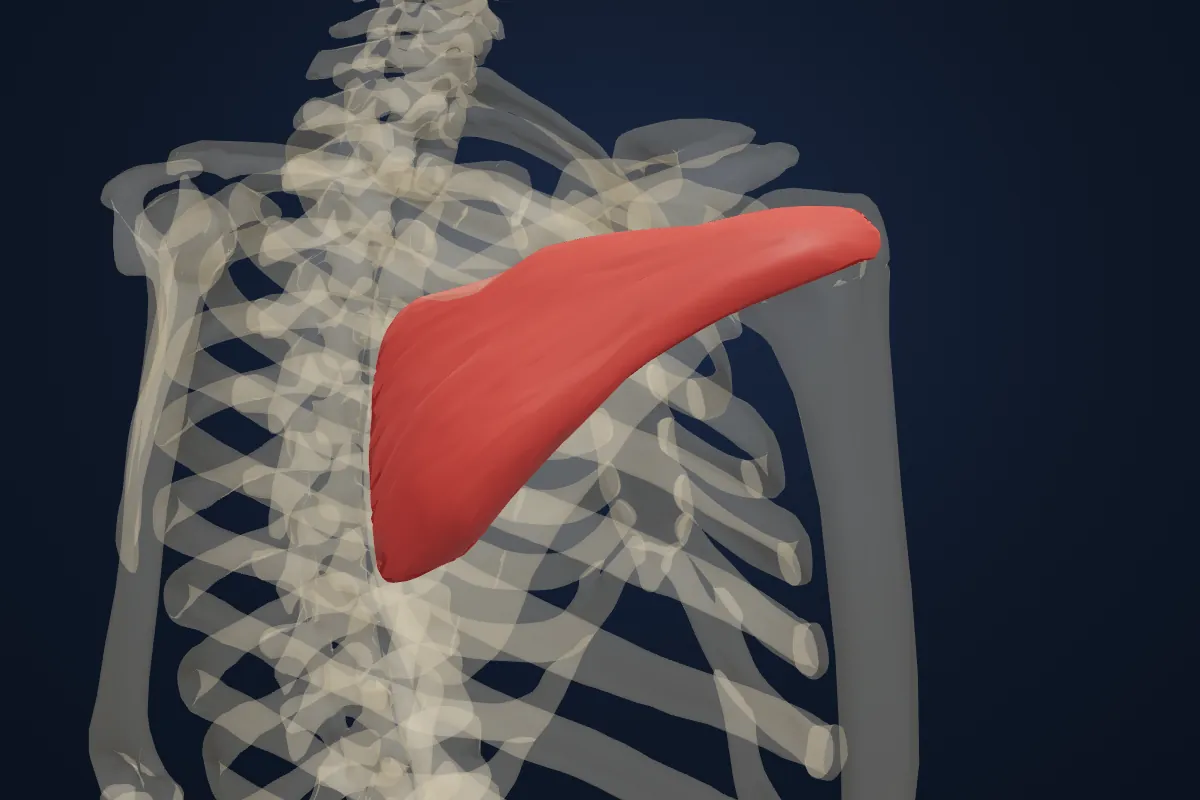
Origin
- Infraspinous fossa of the scapula.
Insertion
- Middle facet of the greater tubercle of the humerus.
Innervation
- Nerve: Suprascapular nerve
- Nerve roots: C5–C6 Sources differ: Segmental (root) levels differ slightly between textbooks; the commonly cited levels are shown.
Actions
- Laterally rotates the arm.
- Stabilises the humeral head in the glenoid cavity.
Synergists and antagonists
- Synergists: Teres minor muscle, Scapular spinal part of deltoid muscle
- Antagonists: Subscapularis muscle, Latissimus dorsi muscle, Teres major muscle
Exercises that load this muscle
- Side-lying external rotation: Lying on one side, elbow bent to 90° at the side, rotate the forearm upwards and lower slowly.
Associated injuries and conditions
Injuries: rotator cuff tear, usually as an extension of a supraspinatus tear.
Conditions: rotator cuff tendinopathy; weakness from suprascapular neuropathy.
MSK Map can also show a grade 1, 2 or 3 strain of this muscle in the app.
Related structures
- Supraspinatus muscle – Rotator cuff
- Teres minor muscle – Rotator cuff
- Subscapularis muscle – Rotator cuff
- Suprascapular nerve – Nerve supply
References
- Standring S (ed). Gray’s Anatomy: The Anatomical Basis of Clinical Practice. 42nd ed. Elsevier; 2020. Section 7: Pectoral girdle and upper limb
- Moore KL, Dalley AF, Agur AMR. Clinically Oriented Anatomy. 9th ed. Wolters Kluwer; 2023. Chapter 6: Upper limb
- Betts JG, et al. Anatomy and Physiology 2e. OpenStax; 2022. CC BY 4.0. 11.5 Muscles of the pectoral girdle and upper limbs (tables) Link
Clinically reviewed and signed off by Arun Gray BSc MSc MSST on 21 November 2026.