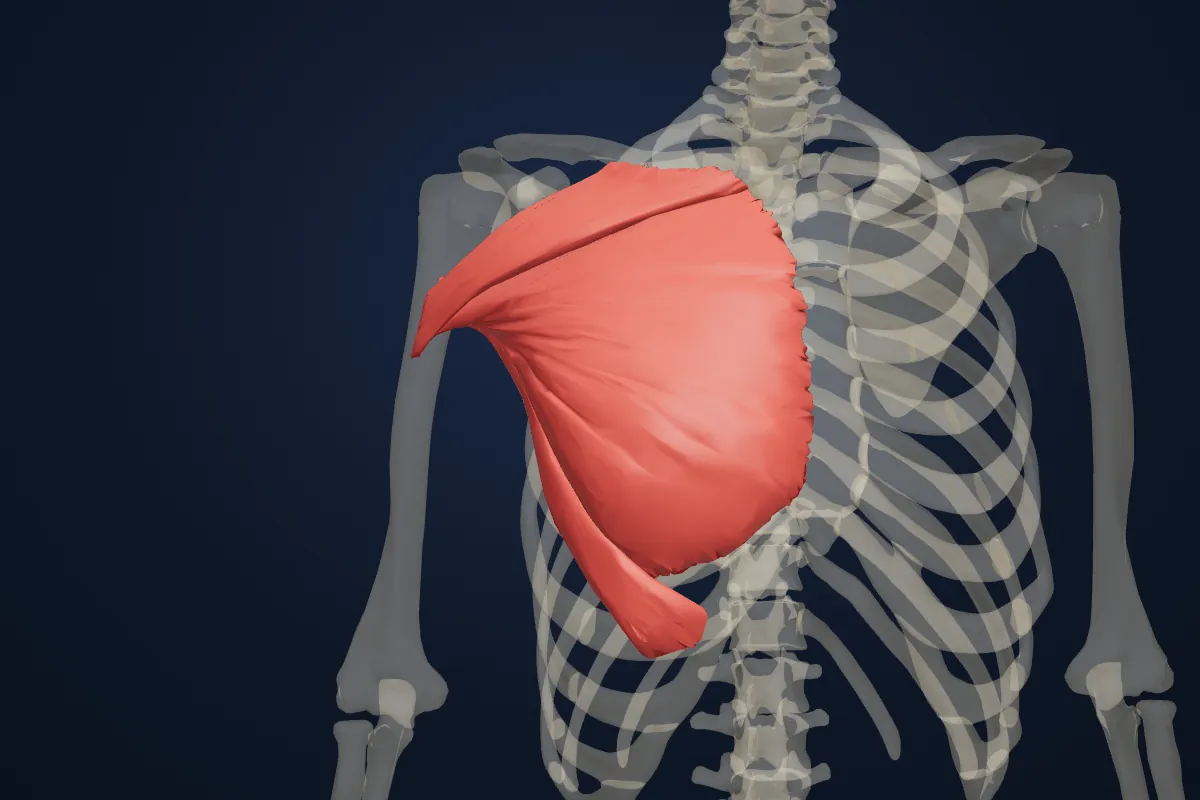
Origin
- Clavicular head: medial half of the clavicle.
- Sternocostal head: sternum and the upper six costal cartilages.
- Abdominal part: aponeurosis of the external oblique.
Insertion
- Lateral lip of the intertubercular (bicipital) groove of the humerus, via a twisted bilaminar tendon.
Innervation
- Nerve: Lateral and medial pectoral nerves
- Nerve roots: C5–T1 (clavicular head mainly C5–C6; sternocostal head C7–T1) Sources differ: Segmental (root) levels differ slightly between textbooks; the commonly cited levels are shown.
Actions
- Adducts and medially rotates the shoulder.
Secondary actions
- Clavicular head flexes the shoulder; sternocostal head extends the flexed shoulder.
- Helps draw the trunk up in climbing.
Synergists and antagonists
- Synergists: Latissimus dorsi muscle, Teres major muscle, Clavicular part of deltoid muscle
- Antagonists: Scapular spinal part of deltoid muscle, Infraspinatus muscle
Exercises that load this muscle
- Bench press / push-up: Lower the chest towards the bar or floor with the elbows about 45° from the body, then press back up.
Associated injuries and conditions
Injuries: pectoralis major tendon rupture (often during bench press); pectoralis major strain.
MSK Map can also show a grade 1, 2 or 3 strain of this muscle in the app.
Related structures
- Pectoralis minor muscle – Lies deep to it
- Latissimus dorsi muscle – Inserts nearby on the humerus
References
- Standring S (ed). Gray’s Anatomy: The Anatomical Basis of Clinical Practice. 42nd ed. Elsevier; 2020. Section 7: Pectoral girdle and upper limb
- Moore KL, Dalley AF, Agur AMR. Clinically Oriented Anatomy. 9th ed. Wolters Kluwer; 2023. Chapter 6: Upper limb
- Betts JG, et al. Anatomy and Physiology 2e. OpenStax; 2022. CC BY 4.0. 11.5 Muscles of the pectoral girdle and upper limbs (tables) Link
Clinically reviewed and signed off by Arun Gray BSc MSc MSST on 23 November 2026.