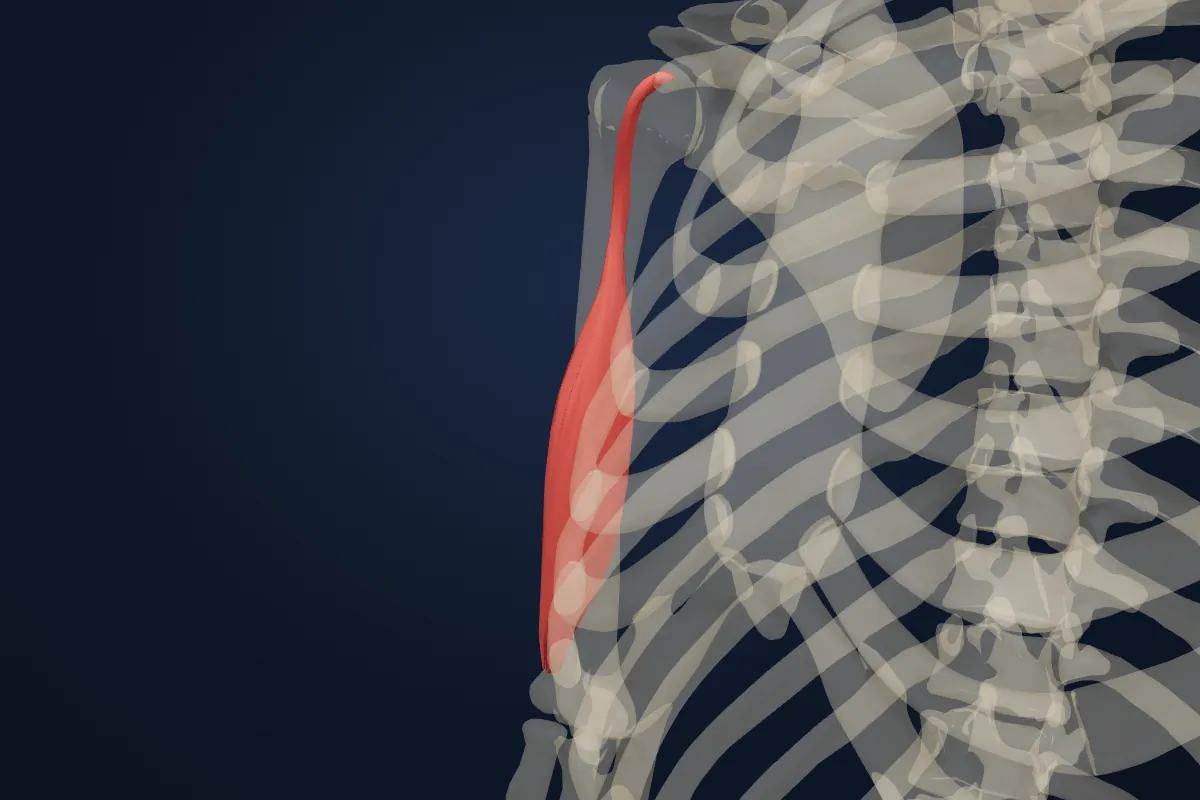
Origin
- Tip of the coracoid process of the scapula (with coracobrachialis).
Insertion
- Radial tuberosity (with the long head) and, via the bicipital aponeurosis, the deep fascia of the forearm.
Innervation
- Nerve: Musculocutaneous nerve
- Nerve roots: C5, C6 Sources differ: Segmental (root) levels differ slightly between textbooks; the commonly cited levels are shown.
Actions
- Supinates the forearm.
- Flexes the elbow.
Secondary actions
- Assists shoulder flexion and adduction.
Synergists and antagonists
- Synergists: Long head of biceps brachii, Brachialis muscle, Brachioradialis muscle
- Antagonists: Triceps brachii muscle
Associated injuries and conditions
Injuries: distal biceps tendon rupture (with the long head).
Conditions: distal biceps tendinopathy.
MSK Map can also show a grade 1, 2 or 3 strain of this muscle in the app.
Related structures
- Long head of biceps brachii – The other head of biceps
- Coracobrachialis muscle – Shares its origin
References
- Standring S (ed). Gray’s Anatomy: The Anatomical Basis of Clinical Practice. 42nd ed. Elsevier; 2020. Section 7: Pectoral girdle and upper limb
- Moore KL, Dalley AF, Agur AMR. Clinically Oriented Anatomy. 9th ed. Wolters Kluwer; 2023. Chapter 6: Upper limb
- Betts JG, et al. Anatomy and Physiology 2e. OpenStax; 2022. CC BY 4.0. 11.5 Muscles of the pectoral girdle and upper limbs (tables) Link
Clinically reviewed and signed off by Arun Gray BSc MSc MSST on 23 November 2026.