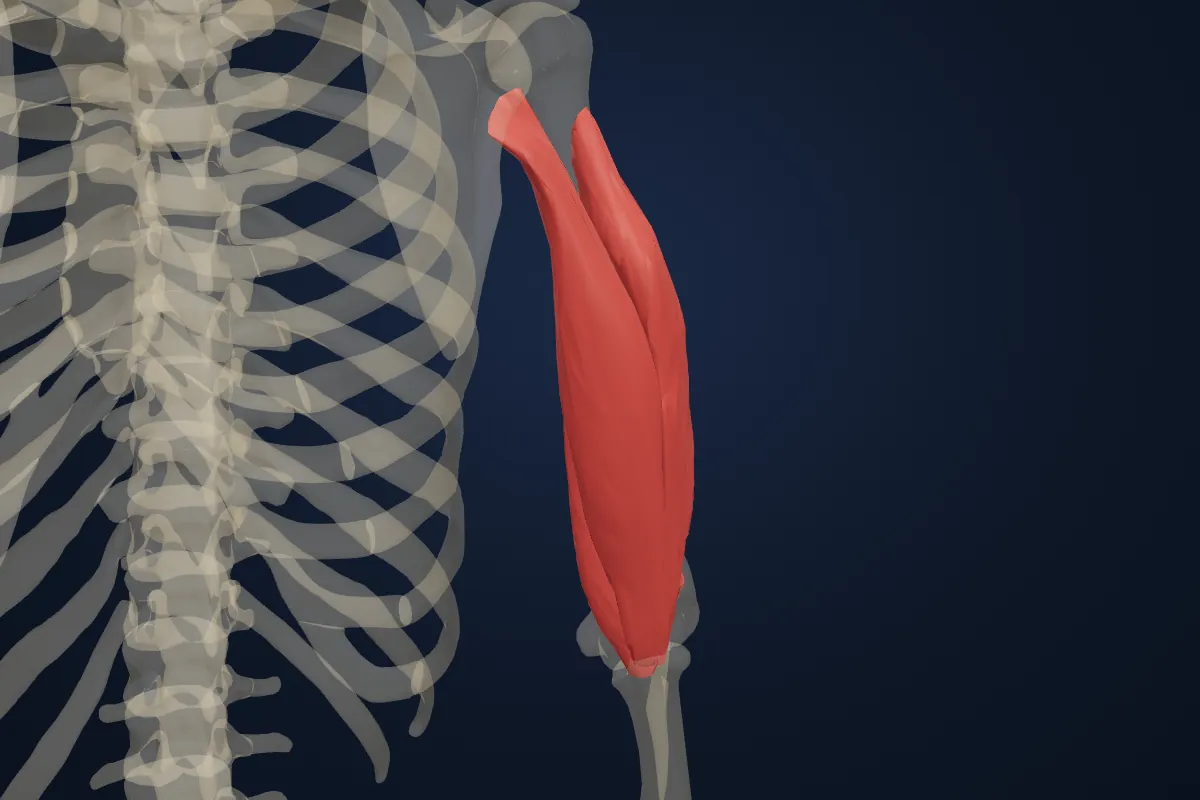
Origin
- Long head: infraglenoid tubercle of the scapula.
- Lateral head: posterior humerus above the radial groove.
- Medial head: posterior humerus below the radial groove.
Insertion
- Olecranon of the ulna (via a common tendon) and the deep fascia of the forearm.
Innervation
- Nerve: Radial nerve (the long head sometimes also from the axillary nerve)
- Nerve roots: C6, C7, C8 Sources differ: Segmental (root) levels differ slightly between textbooks; the commonly cited levels are shown.
Actions
- Extends the elbow (the medial head is active at all loads; the long and lateral heads are recruited for stronger efforts).
Secondary actions
- Long head extends and adducts the shoulder and steadies the humeral head.
Synergists and antagonists
- Synergists: Anconeus muscle
- Antagonists: Brachialis muscle, Long head of biceps brachii
Relations
- The radial nerve spirals between the lateral and medial heads in the radial groove.
Exercises that load this muscle
- Triceps press-down / dip: Elbows by the sides, straighten the elbows against resistance, then return slowly.
Associated injuries and conditions
Injuries: triceps tendon rupture (uncommon).
Conditions: triceps tendinopathy; olecranon bursitis (superficial to its insertion).
MSK Map can also show a grade 1, 2 or 3 strain of this muscle in the app.
Related structures
- Anconeus muscle – Assists elbow extension
- Teres major muscle – Long head passes between it and teres minor
References
- Standring S (ed). Gray’s Anatomy: The Anatomical Basis of Clinical Practice. 42nd ed. Elsevier; 2020. Section 7: Pectoral girdle and upper limb
- Moore KL, Dalley AF, Agur AMR. Clinically Oriented Anatomy. 9th ed. Wolters Kluwer; 2023. Chapter 6: Upper limb
- Betts JG, et al. Anatomy and Physiology 2e. OpenStax; 2022. CC BY 4.0. 11.5 Muscles of the pectoral girdle and upper limbs (tables) Link
Clinically reviewed and signed off by Arun Gray BSc MSc MSST on 23 November 2026.