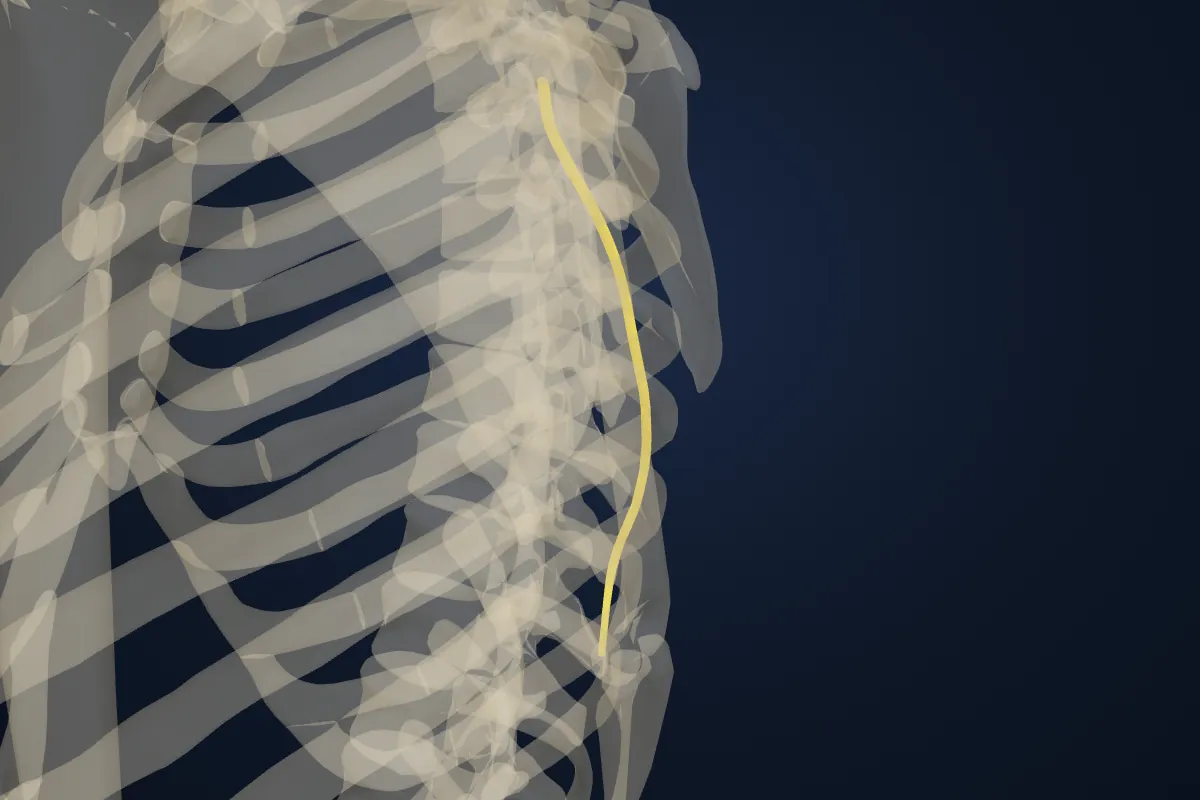
Origin
Posterior cord of the brachial plexus.
Nerve roots
C5–T1 Sources differ: Segmental (root) levels differ slightly between textbooks; the commonly cited levels are shown.
Course
- Runs in the radial (spiral) groove on the back of the humerus with the profunda brachii artery.
- Pierces the lateral intermuscular septum and divides in front of the lateral epicondyle into the superficial (sensory) branch and the posterior interosseous nerve (motor), which passes through supinator.
Motor supply
- Triceps, anconeus, brachioradialis and the wrist extensors (ECRL directly; ECRB variably).
- Via the posterior interosseous nerve: supinator, extensor digitorum, extensor digiti minimi, ECU, abductor pollicis longus, extensor pollicis longus and brevis, and extensor indicis.
Sensory supply
- Posterior arm and forearm; dorsum of the radial hand and the first web space (superficial branch).
Clinical relevance
- Humeral shaft fractures can injure it in the spiral groove, causing wrist drop.
- “Saturday night palsy” from compression in the arm.
- Posterior interosseous nerve compression causes finger-drop without sensory loss; radial tunnel syndrome causes lateral forearm pain.
- Superficial radial nerve irritation at the wrist (Wartenberg syndrome).
Associated injuries and conditions
Injuries: radial nerve palsy with humeral shaft fracture.
Conditions: wrist drop; radial tunnel syndrome; posterior interosseous nerve syndrome; Wartenberg syndrome.
Related structures
- Humerus – Runs in its spiral groove
- Supinator – Its deep branch passes through it
- Extensor carpi radialis brevis – Supplies it
References
- Standring S (ed). Gray’s Anatomy: The Anatomical Basis of Clinical Practice. 42nd ed. Elsevier; 2020. Section 7: Pectoral girdle and upper limb
- Moore KL, Dalley AF, Agur AMR. Clinically Oriented Anatomy. 9th ed. Wolters Kluwer; 2023. Chapter 6: Upper limb
Clinically reviewed and signed off by Arun Gray BSc MSc MSST on 23 November 2026.