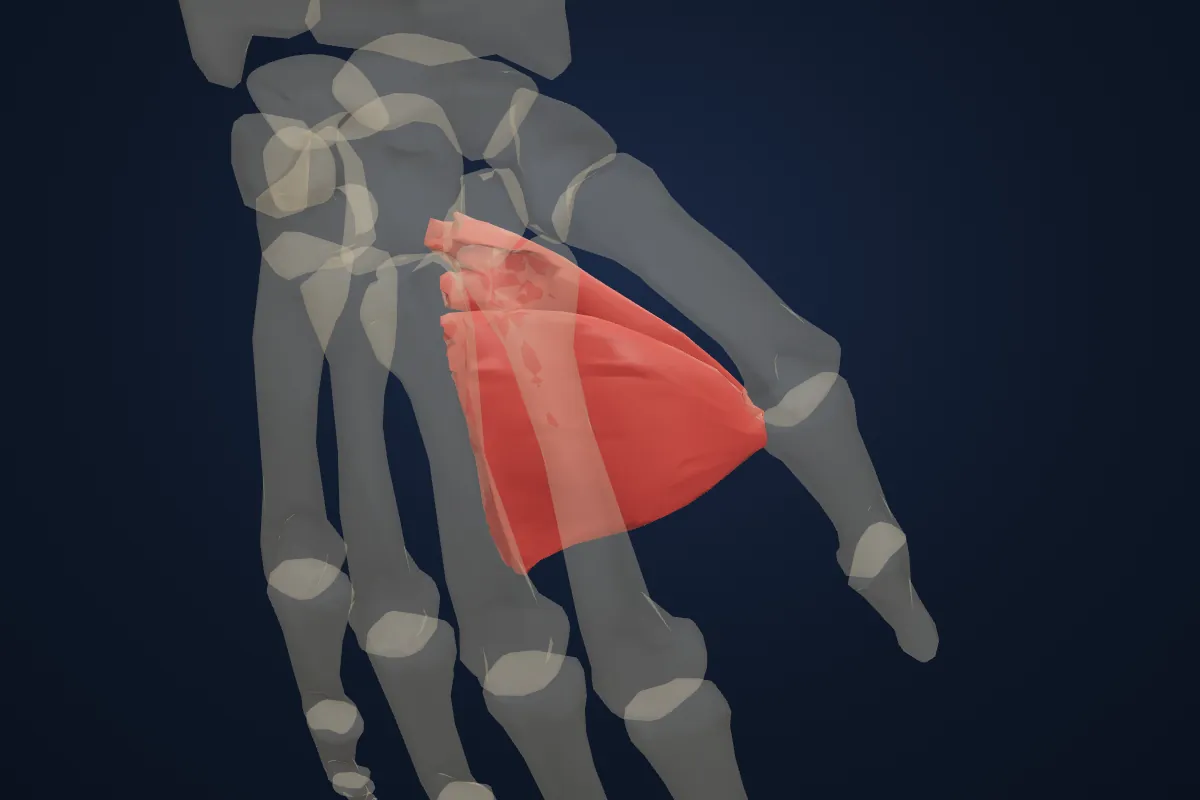
Origin
- Oblique head: bases of the second and third metacarpals and the capitate.
- Transverse head: anterior surface of the shaft of the third metacarpal.
Insertion
- Medial side of the base of the proximal phalanx of the thumb (via the medial sesamoid).
Innervation
- Nerve: Deep branch of the ulnar nerve
- Nerve roots: C8, T1 Sources differ: Segmental (root) levels differ slightly between textbooks; the commonly cited levels are shown.
Actions
- Adducts the thumb.
Secondary actions
- Provides power for key pinch and grip.
Relations
- Froment’s sign (flexing the thumb tip to hold paper) shows its weakness in ulnar nerve palsy.
Associated injuries and conditions
Injuries: ulnar collateral ligament injury of the thumb (“skier’s thumb”) occurs at its insertion region.
Conditions: weak pinch in ulnar nerve palsy (Froment’s sign).
MSK Map can also show a grade 1, 2 or 3 strain of this muscle in the app.
Related structures
- Ulnar nerve – Supplied by its deep branch
References
- Standring S (ed). Gray’s Anatomy: The Anatomical Basis of Clinical Practice. 42nd ed. Elsevier; 2020. Section 7: Pectoral girdle and upper limb
- Moore KL, Dalley AF, Agur AMR. Clinically Oriented Anatomy. 9th ed. Wolters Kluwer; 2023. Chapter 6: Upper limb
- Betts JG, et al. Anatomy and Physiology 2e. OpenStax; 2022. CC BY 4.0. 11.5 Muscles of the pectoral girdle and upper limbs (tables) Link
Clinically reviewed and signed off by Arun Gray BSc MSc MSST on 23 November 2026.