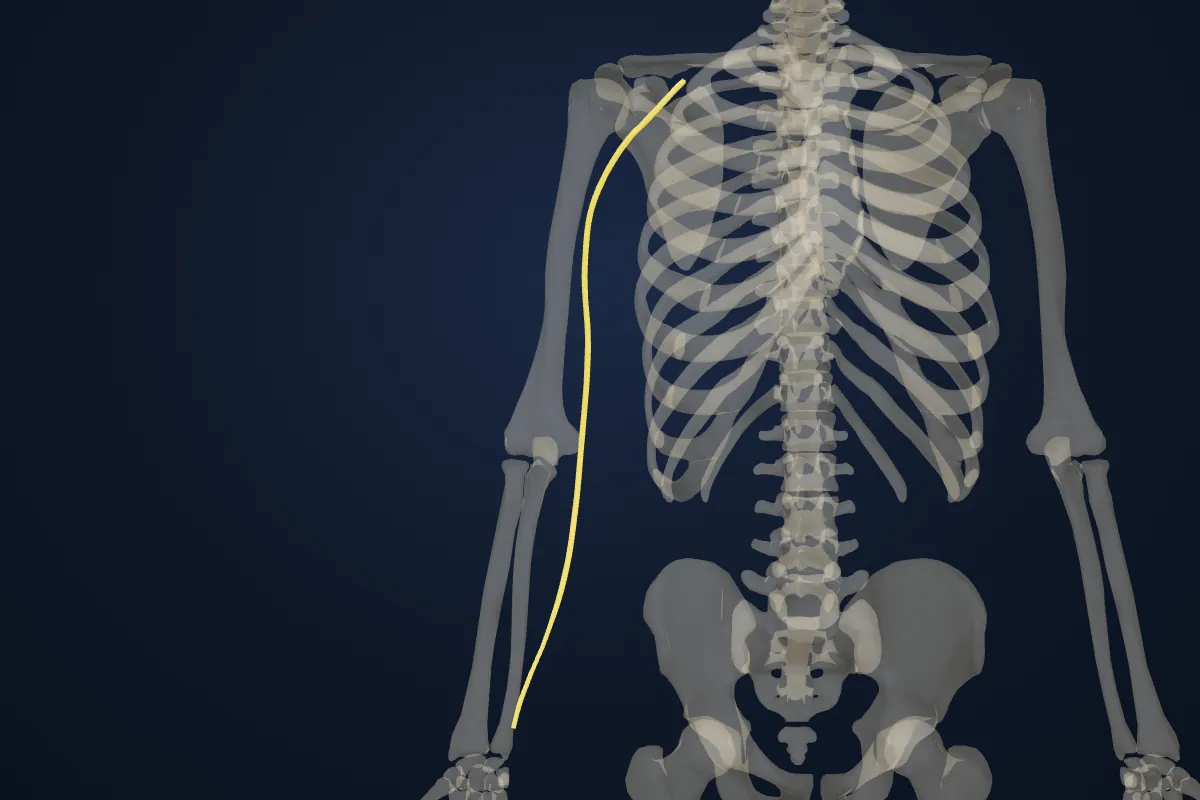
Origin
Medial cord of the brachial plexus.
Nerve roots
C8, T1 (often with fibres from C7) Sources differ: Segmental (root) levels differ slightly between textbooks; the commonly cited levels are shown.
Course
- Descends on the medial arm, passing behind the medial epicondyle in the cubital tunnel.
- Enters the forearm between the heads of flexor carpi ulnaris and runs down the medial forearm.
- Crosses the wrist superficial to the flexor retinaculum through Guyon’s canal into the hand.
Motor supply
- Flexor carpi ulnaris and the ulnar half of flexor digitorum profundus.
- Most intrinsic hand muscles: hypothenar muscles, interossei, the medial two lumbricals, adductor pollicis and the deep head of flexor pollicis brevis.
Sensory supply
- Little finger and the ulnar half of the ring finger (palmar and dorsal), and the ulnar side of the hand.
Clinical relevance
- Cubital tunnel syndrome is the second most common upper-limb entrapment neuropathy.
- Compression in Guyon’s canal (e.g. cyclists) affects the hand only.
Associated injuries and conditions
Injuries: ulnar nerve injury with medial epicondyle fracture.
Conditions: cubital tunnel syndrome; Guyon’s canal (ulnar tunnel) syndrome.
Related structures
- Ulnar collateral ligament – Passes just behind it at the elbow
- Median nerve – The other main nerve to the hand
References
- Standring S (ed). Gray’s Anatomy: The Anatomical Basis of Clinical Practice. 42nd ed. Elsevier; 2020. Section 7: Pectoral girdle and upper limb
- Moore KL, Dalley AF, Agur AMR. Clinically Oriented Anatomy. 9th ed. Wolters Kluwer; 2023. Chapter 6: Upper limb
Clinically reviewed and signed off by Arun Gray BSc MSc MSST on 23 November 2026.