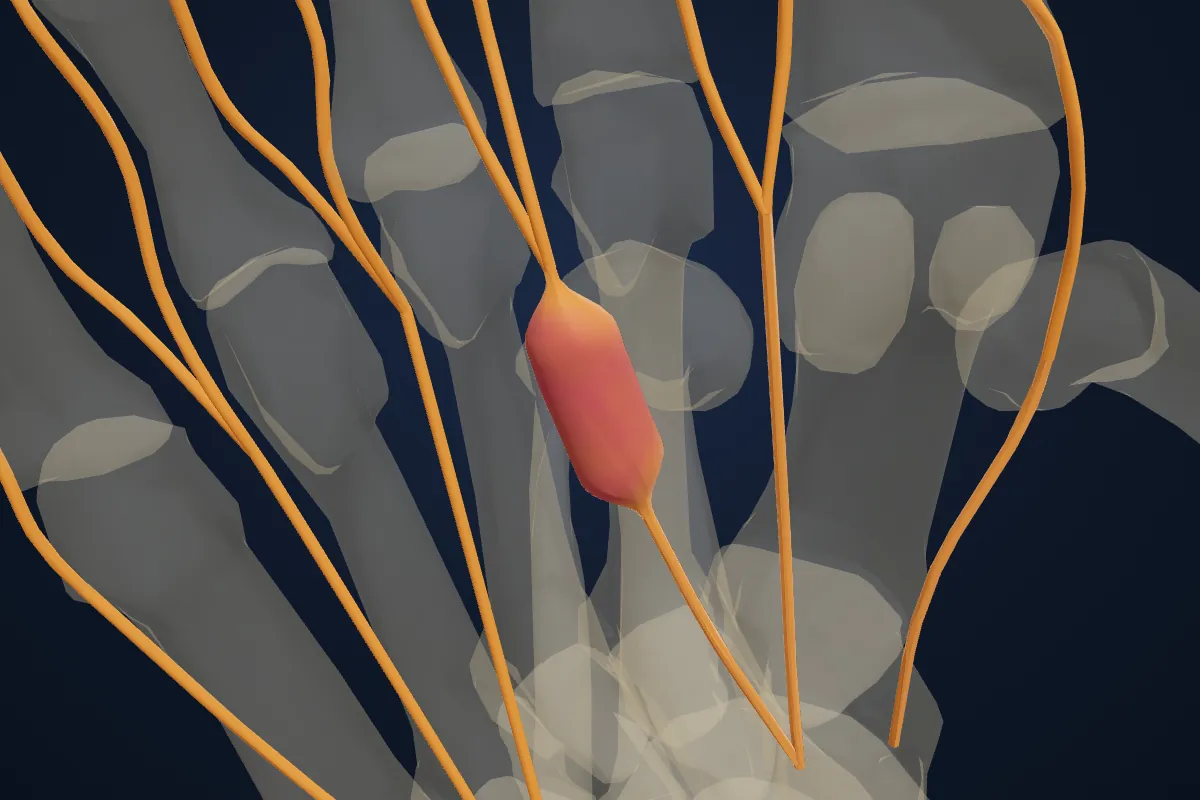
An illustrative model built on the reference anatomy. It does not show any individual patient’s tissue and does not establish a diagnosis.
In plain English
Morton’s neuroma is a thickening of a small nerve between the toes, most often between the 3rd and 4th toes. It causes burning or sharp pain in the ball of the foot, sometimes with tingling into the toes, and a feeling of walking on a pebble. Wider footwear, activity changes and padding help many people; injections or surgery are options if it persists.
What the visualisation shows
- Established damage Thickened common digital nerve to the 3rd web space (between the 3rd and 4th metatarsal heads), the most common site. This nerve also receives a communicating branch from the lateral plantar nerve. Despite the name it is not a true tumour, but thickening and scarring (fibrosis) around the nerve.
- Illustrative convention Fibrous change around the nerve (a visual convention).
Clinical notes
- Perineural fibrosis of a common plantar digital nerve, most often in the 3rd intermetatarsal space (less often the 2nd), at or just distal to the deep transverse metatarsal ligament.
- Forefoot pain reproduced by squeezing the metatarsal heads (Mulder’s click may be present); ultrasound or MRI can confirm.
Mechanism
- Repetitive compression and traction of the nerve under the deep transverse metatarsal ligament, aggravated by narrow or high-heeled footwear.
Structures involved
- Common plantar digital branches of medial plantar nerve
References
- Standring S (ed). Gray’s Anatomy: The Anatomical Basis of Clinical Practice. 42nd ed. Elsevier; 2020. Section 9: Pelvic girdle and lower limb
- Moore KL, Dalley AF, Agur AMR. Clinically Oriented Anatomy. 9th ed. Wolters Kluwer; 2023. Chapter 7: Lower limb
Clinically reviewed and signed off by Arun Gray BSc MSc MSST on 22 November 2026.