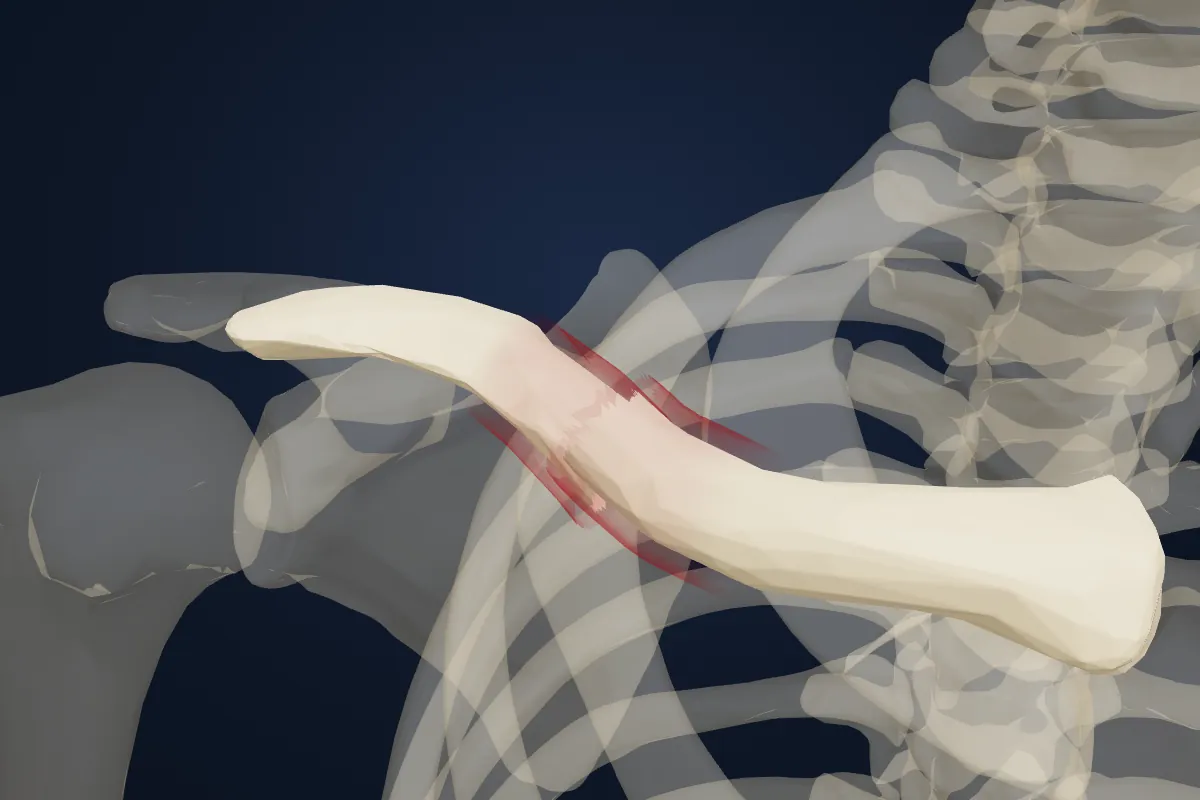
An illustrative model built on the reference anatomy. Fracture lines and displacement are typical examples, not any individual patient’s injury, and it does not establish a diagnosis.
In plain English
A broken collarbone usually happens from a fall onto the shoulder or an outstretched arm, common in cycling and contact sports. There is pain and swelling over the collarbone and the shoulder may drop. Most heal well in a sling followed by gradually returning to movement; surgery is considered for some badly displaced or shortened fractures.
What the visualisation shows
- Typical appearance Fracture of the middle third of the clavicle, the most common site. The outer fragment is pulled down by the weight of the arm and drawn inwards, so the bone shortens and the ends overlap.
- Illustrative convention Bleeding around the fracture (fracture haematoma), shown as a soft glow (a visual convention).
Clinical notes
- Middle-third fractures account for most clavicle fractures. The medial fragment may be elevated by sternocleidomastoid; the lateral fragment displaces inferiorly and medially.
- Operative fixation of displaced midshaft fractures reduces non-union rates but overall functional outcomes are often similar to non-operative care. Sources differ: Management varies.
- Check skin integrity and neurovascular status.
Mechanism
- Fall onto the point of the shoulder; less often a fall onto an outstretched hand or a direct blow.
Structures involved
References
- Standring S (ed). Gray’s Anatomy: The Anatomical Basis of Clinical Practice. 42nd ed. Elsevier; 2020. Section 7: Pectoral girdle and upper limb
- Moore KL, Dalley AF, Agur AMR. Clinically Oriented Anatomy. 9th ed. Wolters Kluwer; 2023. Chapter 6: Upper limb
Clinically reviewed and signed off by Arun Gray BSc MSc MSST on 22 November 2026.