An illustrative model built on the reference anatomy. It does not show any individual patient’s tissue and does not establish a diagnosis.
Type I AC joint injury
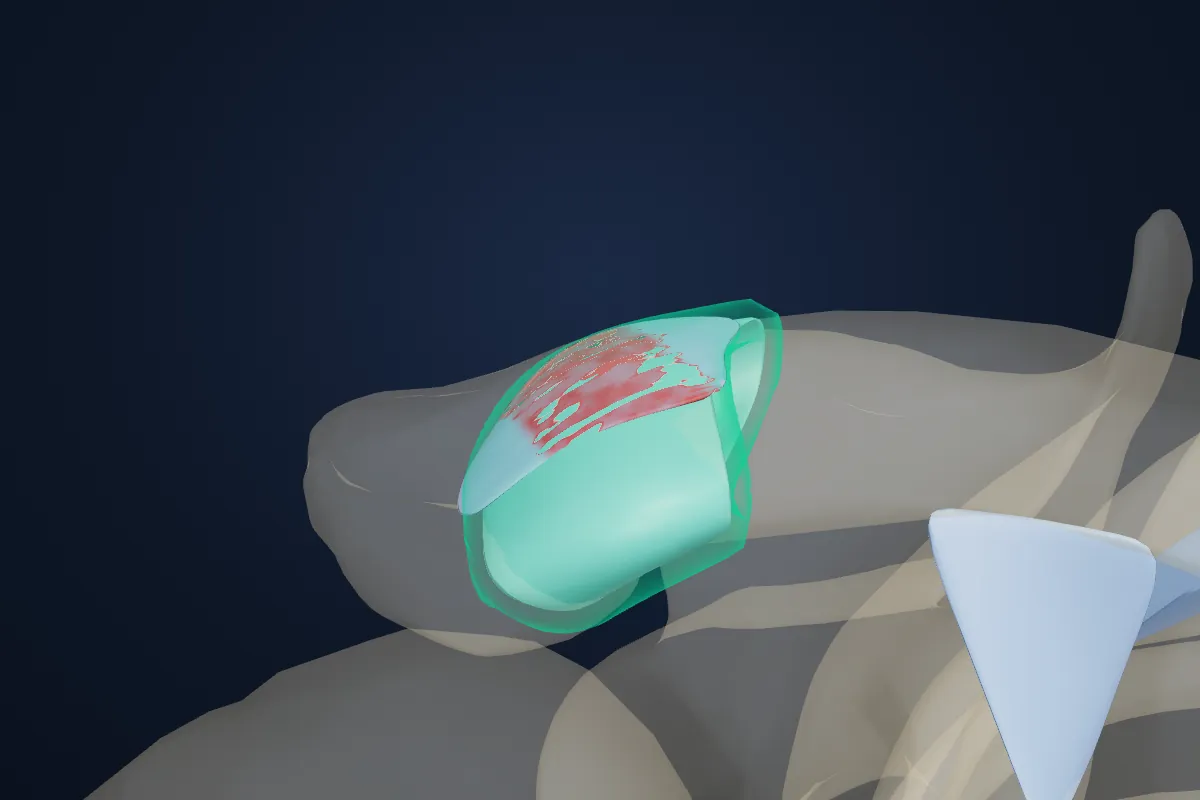
In plain English
A type I AC joint injury is a sprain of the ligament joining the collarbone to the top of the shoulder blade. The joint is tender and sore to move, but stays in position. It usually settles within a few weeks.
What the visualisation shows
- Illustrative convention Sprain of the acromioclavicular ligament with a few torn fibres (enlarged so they can be seen); the joint is not displaced.
- Typical appearance Minor bleeding in the ligament.
- Illustrative convention Swelling around the joint, shown as a translucent shell (a visual convention).
Clinical notes
- Rockwood type I: sprain of the acromioclavicular ligaments; coracoclavicular ligaments intact; no displacement.
- Types IV–VI (posterior, severe superior and inferior displacement, with deltotrapezial fascia disruption) are not shown and are generally treated surgically.
- Management of type III injuries (non-operative vs surgical) remains debated. Sources differ: Management varies.
Mechanism
- A fall or direct blow onto the point of the shoulder with the arm by the side.
Type II AC joint injury
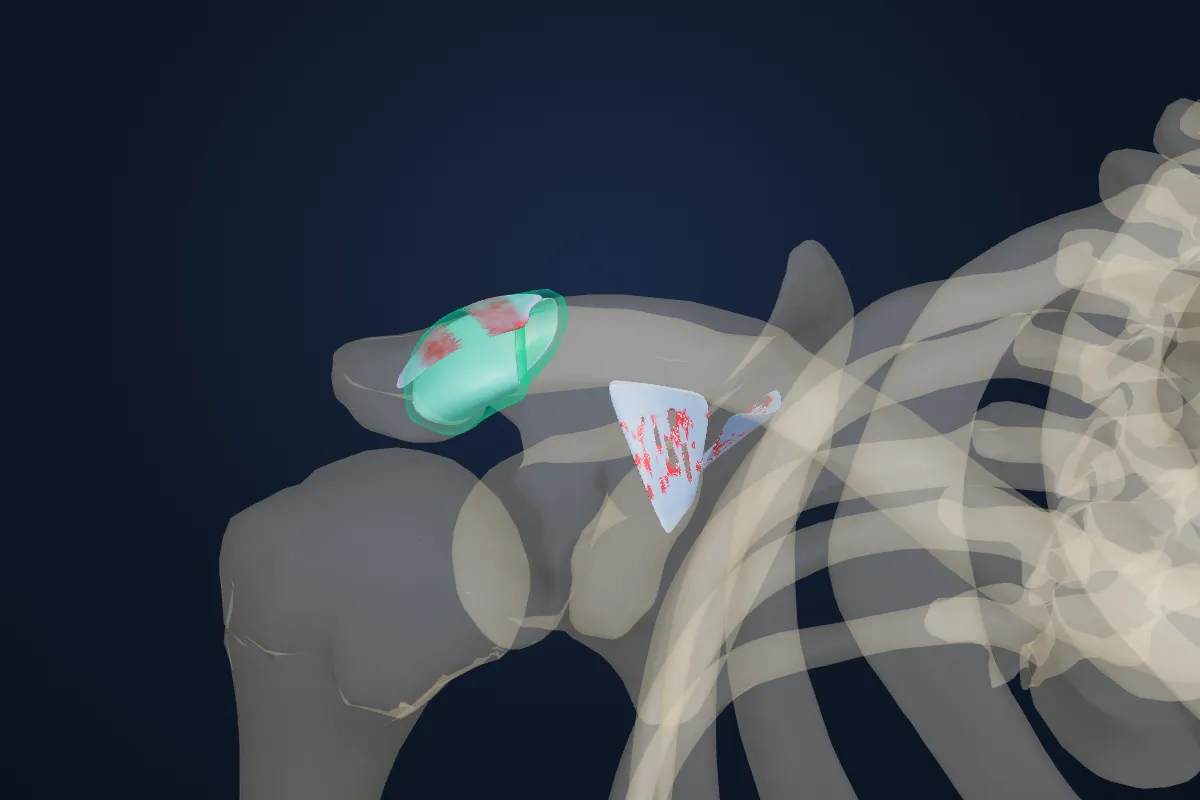
In plain English
In a type II AC joint injury the ligament around the joint is torn and the deeper ligaments holding the collarbone down are stretched. The end of the collarbone may sit slightly higher. Most recover well with rehabilitation over several weeks.
What the visualisation shows
- Established damage Acromioclavicular ligament (and joint capsule) torn through.
- Typical appearance Bleeding from the torn ligament.
- Typical appearance The conoid ligament (one of the coracoclavicular ligaments) is sprained but intact.
- Typical appearance The trapezoid ligament (one of the coracoclavicular ligaments) is sprained but intact.
- Illustrative convention Swelling around the joint, shown as a translucent shell (a visual convention).
Clinical notes
- Rockwood type II: acromioclavicular ligaments and capsule torn; coracoclavicular ligaments sprained but intact; slight vertical subluxation.
- Types IV–VI (posterior, severe superior and inferior displacement, with deltotrapezial fascia disruption) are not shown and are generally treated surgically.
- Management of type III injuries (non-operative vs surgical) remains debated. Sources differ: Management varies.
Mechanism
- A fall or direct blow onto the point of the shoulder with the arm by the side.
Type III AC joint injury
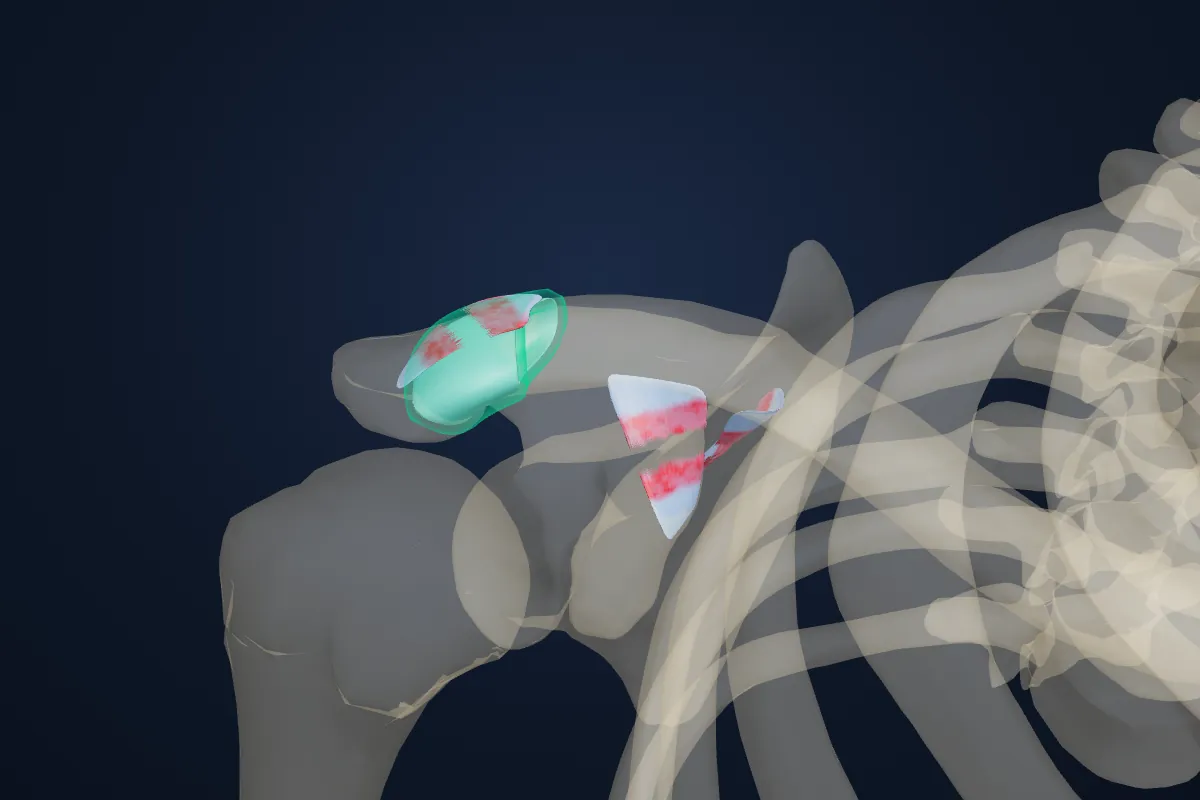
In plain English
In a type III AC joint injury both sets of ligaments are torn, so the shoulder drops away from the collarbone and a step is visible. Many people still recover well with rehabilitation; surgery is considered for some, for example manual workers or overhead athletes.
What the visualisation shows
- Established damage Acromioclavicular ligament (and joint capsule) torn through.
- Typical appearance Bleeding from the torn ligament.
- Established damage The conoid ligament (one of the coracoclavicular ligaments) is torn through. With both coracoclavicular ligaments torn, the shoulder drops away from the clavicle, giving a visible step (not shown: bones are not moved in this model).
- Typical appearance Bleeding from the torn ligament.
- Established damage The trapezoid ligament (one of the coracoclavicular ligaments) is torn through. With both coracoclavicular ligaments torn, the shoulder drops away from the clavicle, giving a visible step (not shown: bones are not moved in this model).
- Typical appearance Bleeding from the torn ligament.
- Illustrative convention Swelling around the joint, shown as a translucent shell (a visual convention).
Clinical notes
- Rockwood type III: acromioclavicular and coracoclavicular ligaments torn; superior displacement of the clavicle relative to the acromion (coracoclavicular distance increased by about 25–100%).
- Types IV–VI (posterior, severe superior and inferior displacement, with deltotrapezial fascia disruption) are not shown and are generally treated surgically.
- Management of type III injuries (non-operative vs surgical) remains debated. Sources differ: Management varies.
Mechanism
- A fall or direct blow onto the point of the shoulder with the arm by the side.
Structures involved
- Acromioclavicular ligament
- Articular capsule of acromioclavicular joint
- Conoid ligament
- Trapezoid ligament
References
- Standring S (ed). Gray’s Anatomy: The Anatomical Basis of Clinical Practice. 42nd ed. Elsevier; 2020. Section 7: Pectoral girdle and upper limb
- Moore KL, Dalley AF, Agur AMR. Clinically Oriented Anatomy. 9th ed. Wolters Kluwer; 2023. Chapter 6: Upper limb
Clinically reviewed and signed off by Arun Gray BSc MSc MSST on 22 November 2026.