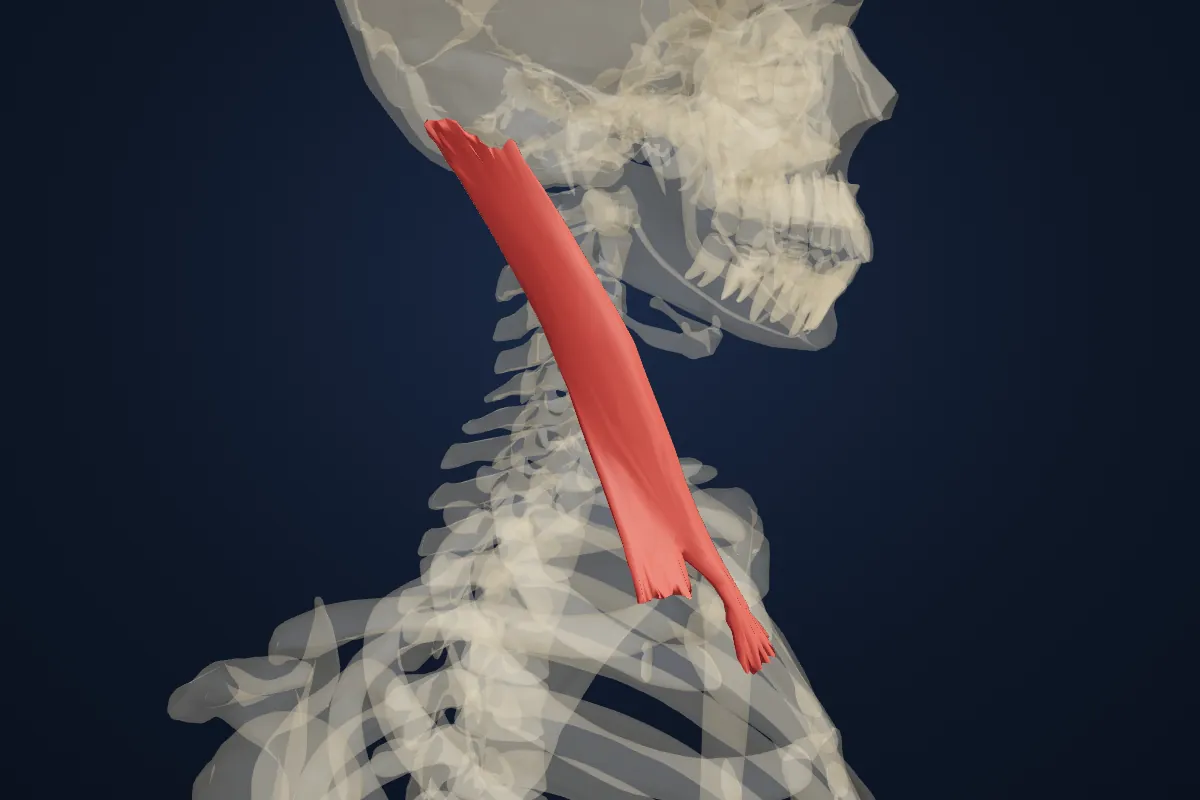
Origin
- Sternal head: anterior surface of the manubrium.
- Clavicular head: medial third of the clavicle.
Insertion
- Mastoid process of the temporal bone and the lateral superior nuchal line.
Innervation
- Nerve: Spinal accessory nerve (CN XI); proprioception from C2–C3
- Nerve roots: Motor: accessory nerve (CN XI) Note: Sensory/proprioceptive supply from C2–C3.
Actions
- One side: side-bends the neck to the same side and rotates the face to the opposite side.
- Both sides: flex the neck and, with the head fixed, assist forced inspiration.
Synergists and antagonists
- Synergists: Scalenus anterior muscle
Associated injuries and conditions
Injuries: whiplash-associated neck strain.
Conditions: torticollis (wry neck); cervicogenic headache contributions.
MSK Map can also show a grade 1, 2 or 3 strain of this muscle in the app.
Related structures
- Trapezius muscle – Shares its nerve supply
- Clavicle – Arises from its medial third
References
- Standring S (ed). Gray’s Anatomy: The Anatomical Basis of Clinical Practice. 42nd ed. Elsevier; 2020. Section 4: Neck
- Moore KL, Dalley AF, Agur AMR. Clinically Oriented Anatomy. 9th ed. Wolters Kluwer; 2023. Chapter 9: Neck
Clinically reviewed and signed off by Arun Gray BSc MSc MSST on 23 November 2026.