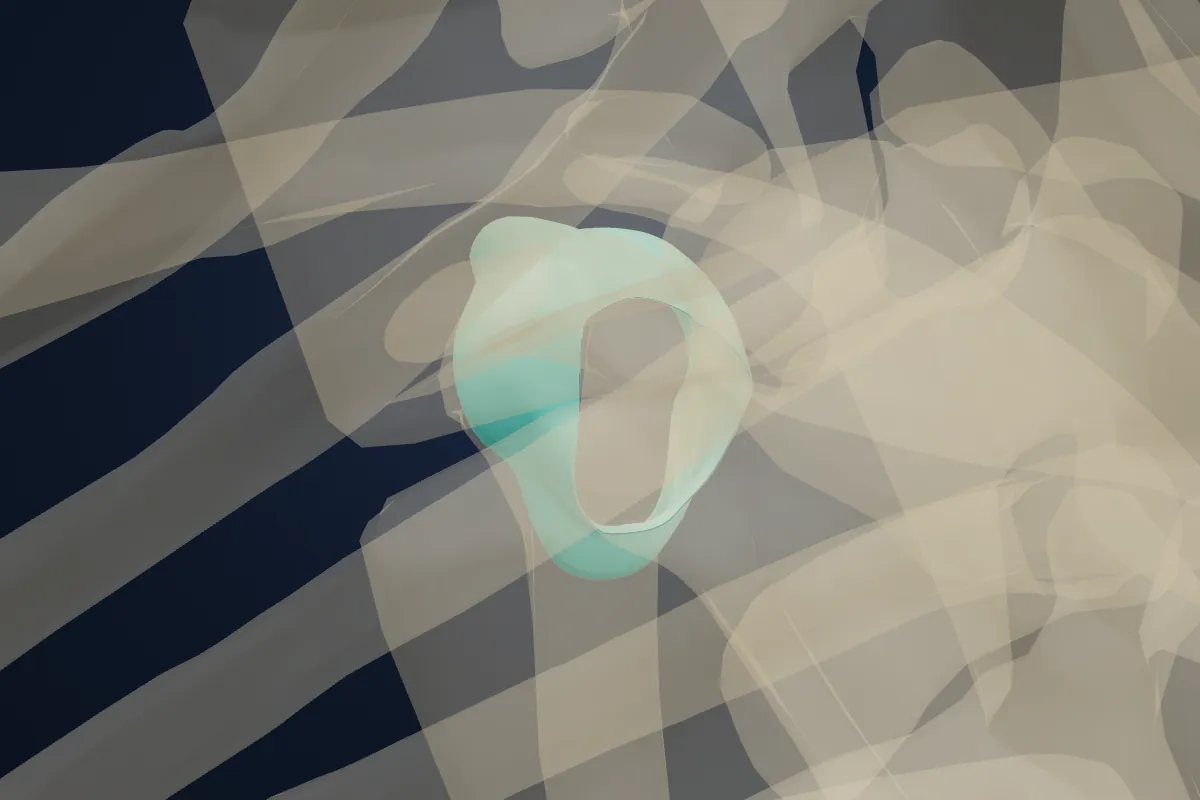
Description
- A lax fibrous capsule enclosing the glenohumeral joint, lined by synovial membrane.
- Thickened anteriorly into the superior, middle and inferior glenohumeral ligaments; reinforced by the rotator cuff tendons, which blend with it.
Attachments
- Glenoid: margin of the glenoid and the labrum.
- Humerus: anatomical neck, extending further down medially onto the shaft.
Function
- Allows a very large range of motion; stability comes mainly from the rotator cuff, the labrum and the capsular ligaments at the ends of range.
- The redundant inferior pouch (axillary recess) tightens in abduction.
Clinical relevance
- Frozen shoulder (adhesive capsulitis) involves thickening and contracture of the capsule, especially the rotator interval and coracohumeral ligament.
- Capsular laxity contributes to multidirectional instability.
Associated injuries and conditions
Injuries: capsular tear with shoulder dislocation.
Conditions: frozen shoulder (adhesive capsulitis); multidirectional instability.
Related structures
- Inferior glenohumeral ligament – Capsular thickening
- Coracohumeral ligament – Reinforces its upper part
- Glenoid labrum – Capsule attaches to it
References
- Standring S (ed). Gray’s Anatomy: The Anatomical Basis of Clinical Practice. 42nd ed. Elsevier; 2020. Section 7: Pectoral girdle and upper limb
- Moore KL, Dalley AF, Agur AMR. Clinically Oriented Anatomy. 9th ed. Wolters Kluwer; 2023. Chapter 6: Upper limb
Clinically reviewed and signed off by Arun Gray BSc MSc MSST on 23 November 2026.