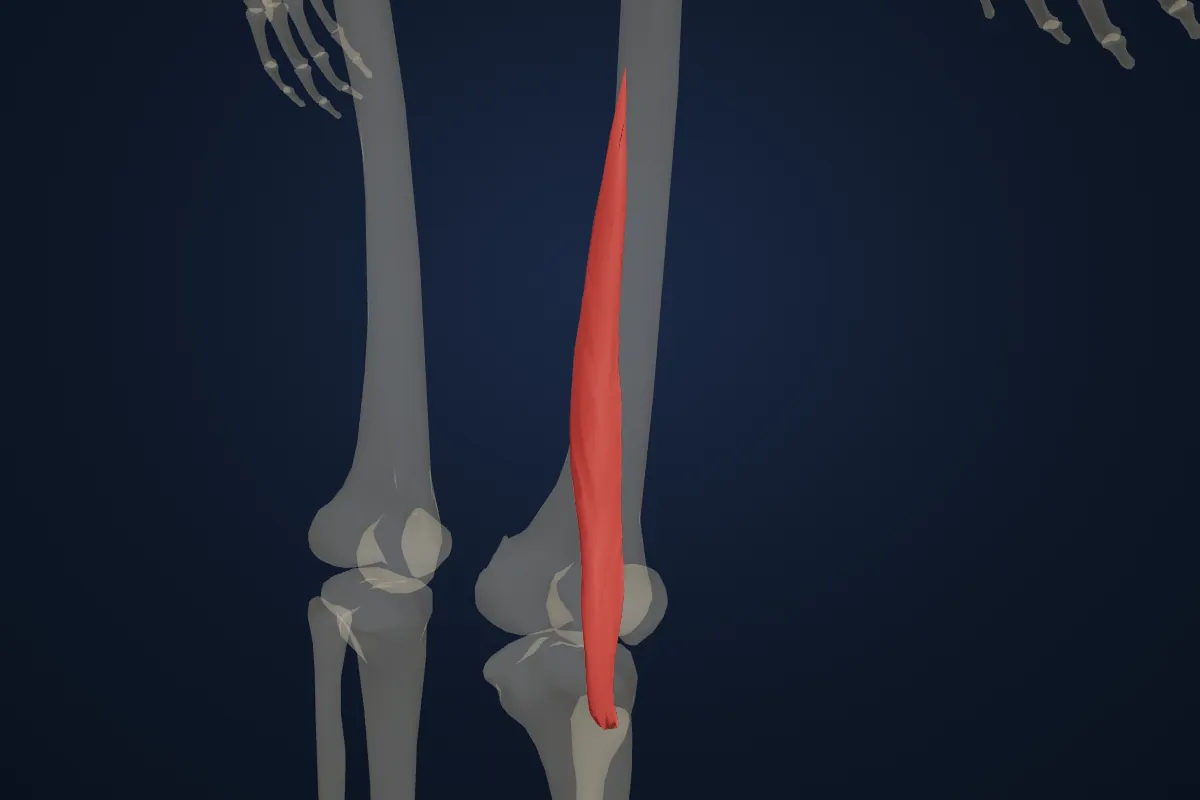
Origin
- Lateral lip of the linea aspera and the lateral supracondylar line of the femur.
Insertion
- Lateral side of the head of the fibula (with the long head).
Innervation
- Nerve: Common fibular division of the sciatic nerve
- Nerve roots: L5–S2 Sources differ: Segmental (root) levels differ slightly between textbooks; the commonly cited levels are shown.
Actions
- Flexes the knee.
Secondary actions
- Laterally rotates the flexed knee.
Synergists and antagonists
- Synergists: Long head of biceps femoris, Semitendinosus muscle, Semimembranosus muscle
- Antagonists: Vastus lateralis muscle, Vastus medialis muscle, Vastus intermedius muscle
Relations
- The only hamstring muscle supplied by the common fibular division; often excluded from the "true" hamstrings because it crosses only the knee.
Exercises that load this muscle
- Nordic hamstring curl: Kneeling with the ankles held, lower the trunk forwards as slowly as possible by resisting with the hamstrings, then return. Caution: High eccentric load; usually introduced gradually.
Associated injuries and conditions
MSK Map can also show a grade 1, 2 or 3 strain of this muscle in the app.
References
- Standring S (ed). Gray’s Anatomy: The Anatomical Basis of Clinical Practice. 42nd ed. Elsevier; 2020. Section 9: Pelvic girdle and lower limb
- Moore KL, Dalley AF, Agur AMR. Clinically Oriented Anatomy. 9th ed. Wolters Kluwer; 2023. Chapter 7: Lower limb
- Betts JG, et al. Anatomy and Physiology 2e. OpenStax; 2022. CC BY 4.0. 11.6 Appendicular muscles of the pelvic girdle and lower limbs (tables) Link
Clinically reviewed and signed off by Arun Gray BSc MSc MSST on 21 November 2026.