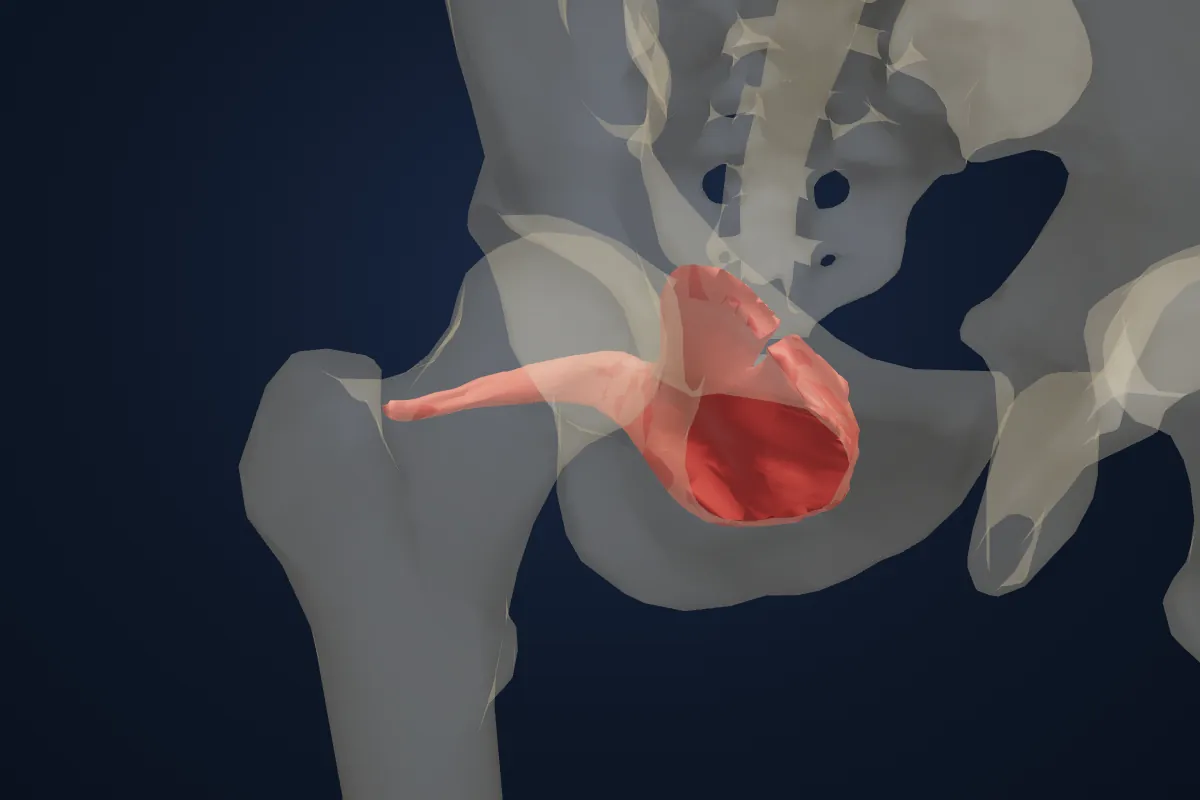
Origin
- Pelvic surface of the obturator membrane and the surrounding bone.
Insertion
- Medial surface of the greater trochanter (trochanteric fossa region), with the gemelli.
Innervation
- Nerve: Nerve to obturator internus
- Nerve roots: L5, S1, S2 Sources differ: Segmental (root) levels differ slightly between textbooks; the commonly cited levels are shown.
Actions
- Laterally rotates the extended hip.
Secondary actions
- Abducts the flexed hip; helps hold the femoral head in the acetabulum.
Synergists and antagonists
- Synergists: Superior gemellus muscle, Inferior gemellus muscle, Piriformis muscle, Quadratus femoris muscle
Relations
- Leaves the pelvis through the lesser sciatic foramen, turning around the lesser sciatic notch.
- Its upper part forms part of the lateral wall of the pelvis and the origin of levator ani.
Associated injuries and conditions
Conditions: deep gluteal syndrome (one of several possible causes).
MSK Map can also show a grade 1, 2 or 3 strain of this muscle in the app.
Related structures
- Superior gemellus muscle – The gemelli insert with it
- Piriformis muscle – Deep lateral rotator above it
References
- Standring S (ed). Gray’s Anatomy: The Anatomical Basis of Clinical Practice. 42nd ed. Elsevier; 2020. Section 9: Pelvic girdle and lower limb
- Moore KL, Dalley AF, Agur AMR. Clinically Oriented Anatomy. 9th ed. Wolters Kluwer; 2023. Chapter 7: Lower limb
- Betts JG, et al. Anatomy and Physiology 2e. OpenStax; 2022. CC BY 4.0. 11.6 Appendicular muscles of the pelvic girdle and lower limbs (tables) Link
Clinically reviewed and signed off by Arun Gray BSc MSc MSST on 23 November 2026.