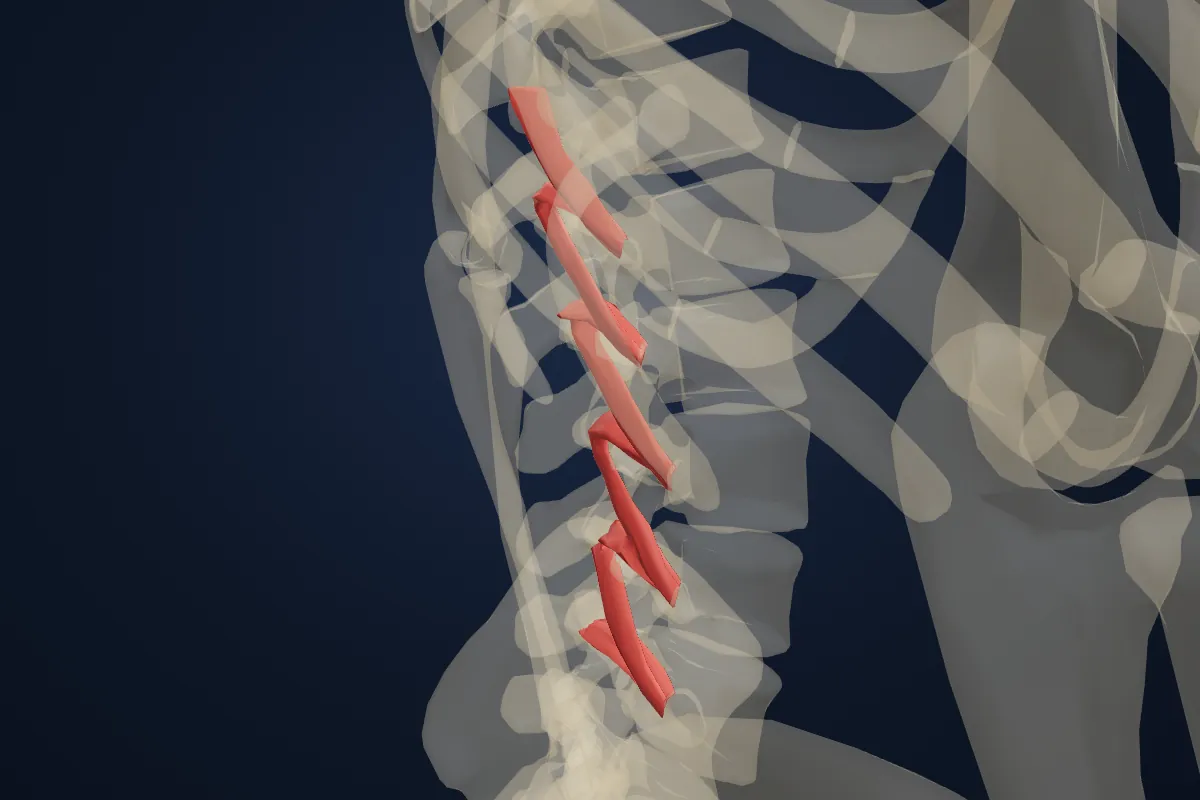
Origin
- Sacrum, the posterior superior iliac spine region, the erector spinae aponeurosis and the mammillary processes of the lumbar vertebrae.
Insertion
- Spinous processes of vertebrae two to four levels above.
Innervation
- Nerve: Medial branches of the posterior (dorsal) rami of the spinal nerves
- Nerve roots: Segmental, at each lumbar level
Actions
- Extends the lumbar spine (both sides) and stabilises individual segments.
Secondary actions
- Contributes to rotation and side-bending to a small degree. Note: Its rotational role is minor compared with its extensor and segmental control roles.
Synergists and antagonists
- Synergists: Quadratus lumborum muscle
Relations
- Lies deepest in the lumbar groove, beneath the erector spinae.
Associated injuries and conditions
Conditions: reduced size and fatty infiltration reported in some people with low back pain (cause and effect unclear).
MSK Map can also show a grade 1, 2 or 3 strain of this muscle in the app.
Related structures
- Quadratus lumborum muscle – Deep low back muscle
- Transversus abdominis muscle – Often trained together in back rehabilitation
References
- Standring S (ed). Gray’s Anatomy: The Anatomical Basis of Clinical Practice. 42nd ed. Elsevier; 2020. Section 5: Back
- Moore KL, Dalley AF, Agur AMR. Clinically Oriented Anatomy. 9th ed. Wolters Kluwer; 2023. Chapter 2: Back
Clinically reviewed and signed off by Arun Gray BSc MSc MSST on 23 November 2026.