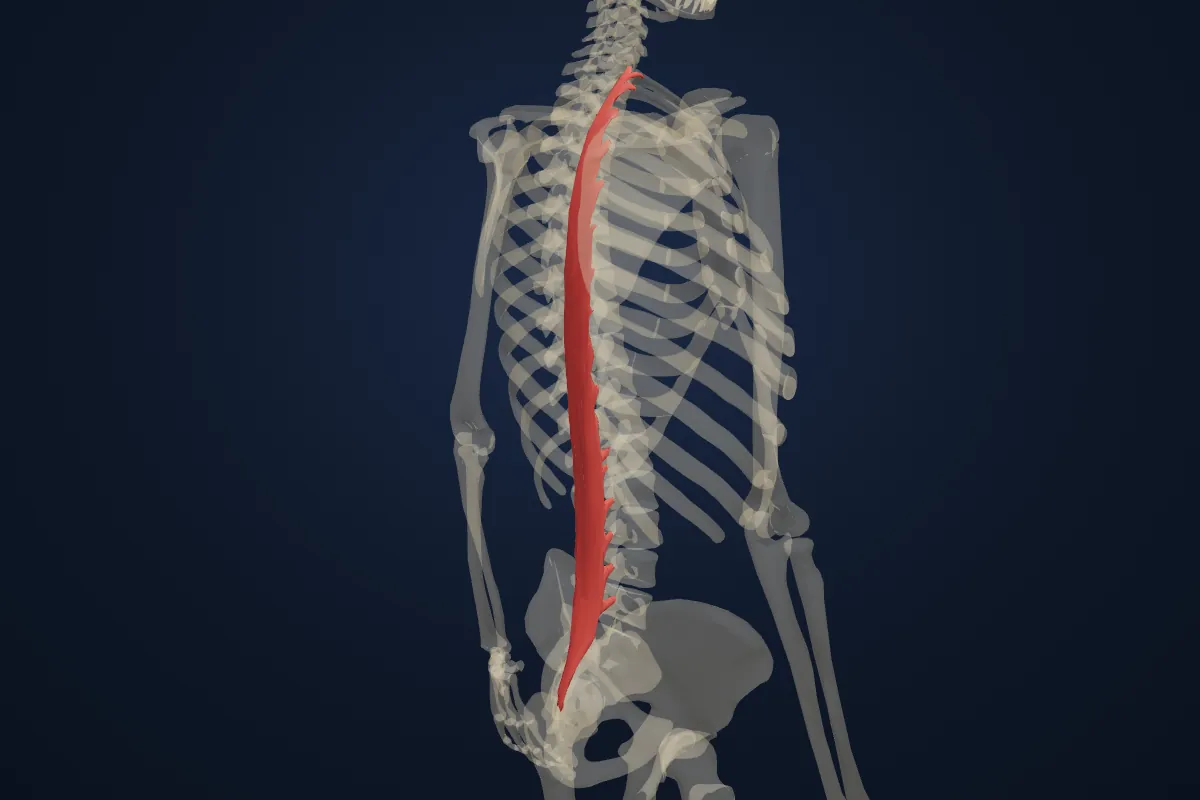
Origin
- Erector spinae aponeurosis (sacrum, iliac crest, lumbar spinous processes) and the lumbar transverse processes.
Insertion
- Transverse processes of the thoracic vertebrae and the ribs between their tubercles and angles.
Innervation
- Nerve: Lateral branches of the posterior rami of the spinal nerves
- Nerve roots: Segmental
Actions
- Extends the spine (both sides); side-bends it (one side).
Synergists and antagonists
- Synergists: Iliocostalis lumborum muscle, Spinalis thoracis muscle
- Antagonists: Rectus abdominis muscle
Associated injuries and conditions
Injuries: back muscle strain.
Conditions: non-specific low back pain.
MSK Map can also show a grade 1, 2 or 3 strain of this muscle in the app.
Related structures
- Iliocostalis lumborum muscle – Erector spinae column lateral to it
- Spinalis thoracis muscle – Erector spinae column medial to it
References
- Standring S (ed). Gray’s Anatomy: The Anatomical Basis of Clinical Practice. 42nd ed. Elsevier; 2020. Section 5: Back
- Moore KL, Dalley AF, Agur AMR. Clinically Oriented Anatomy. 9th ed. Wolters Kluwer; 2023. Chapter 2: Back
Clinically reviewed and signed off by Arun Gray BSc MSc MSST on 23 November 2026.