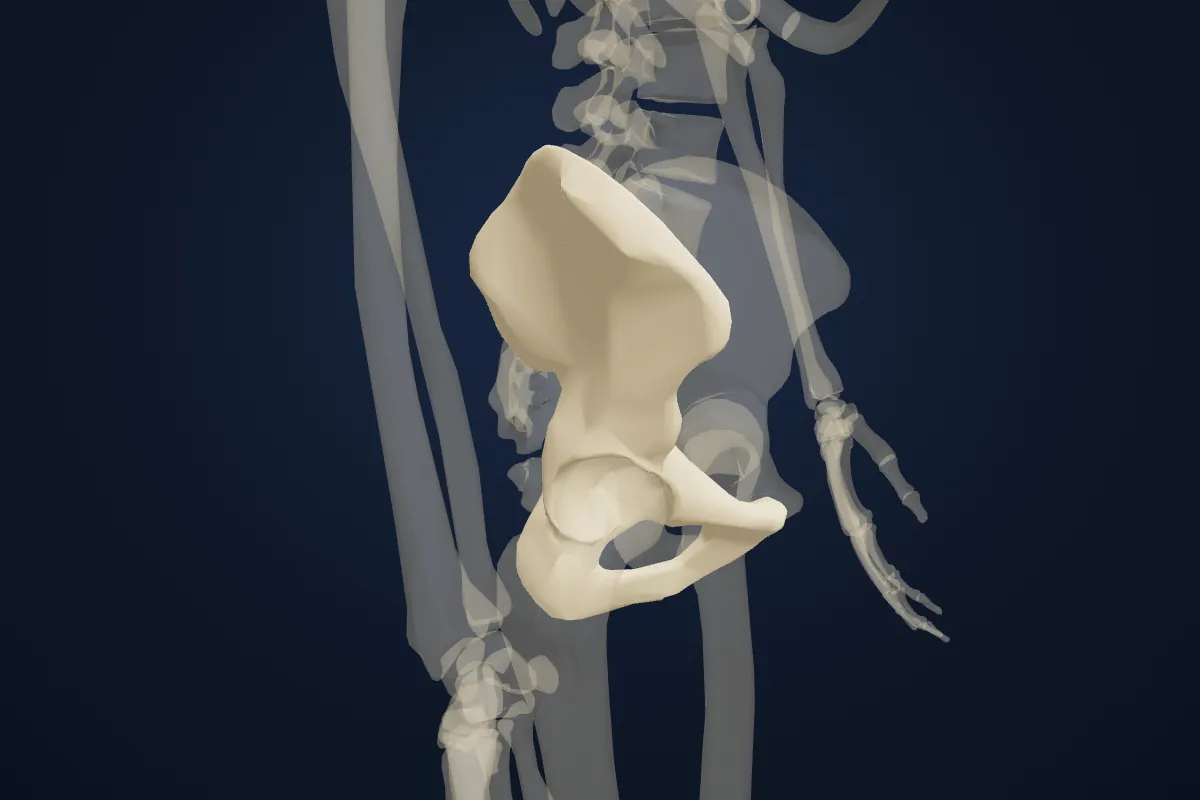
Landmarks
- Ilium: iliac crest, ASIS, AIIS, PSIS, iliac fossa, gluteal lines.
- Ischium: ischial tuberosity and spine.
- Pubis: body, superior and inferior rami, pubic tubercle and symphyseal surface.
- Acetabulum (hip socket) and obturator foramen.
Articulations
- Sacrum (sacroiliac joint).
- Opposite hip bone (pubic symphysis).
- Femoral head (hip joint).
Attachments
- Abdominal and back muscles to the iliac crest; gluteals to the outer ilium; iliacus to the iliac fossa; sartorius (ASIS), rectus femoris (AIIS), hamstrings (ischial tuberosity) and adductors (pubis).
Clinical relevance
- Apophyseal avulsion fractures (ASIS, AIIS, ischial tuberosity) occur in adolescent athletes.
- Pelvic stress fractures and pubic bone stress injury occur in runners and footballers.
- Pelvic ring fractures range from low-energy fragility fractures to life-threatening high-energy injuries.
Associated injuries and conditions
Injuries: pelvic fracture; apophyseal avulsion fracture.
Conditions: pubic bone stress injury (osteitis pubis); sacroiliac joint pain; hip dysplasia.
Related structures
- Sacrum – Forms the sacroiliac joints with it
- Femur – Forms the hip joint with it
- Acetabular labrum – Lines the acetabular rim
References
- Standring S (ed). Gray’s Anatomy: The Anatomical Basis of Clinical Practice. 42nd ed. Elsevier; 2020. Section 9: Pelvic girdle and lower limb
- Moore KL, Dalley AF, Agur AMR. Clinically Oriented Anatomy. 9th ed. Wolters Kluwer; 2023. Chapter 7: Lower limb
Clinically reviewed and signed off by Arun Gray BSc MSc MSST on 23 November 2026.