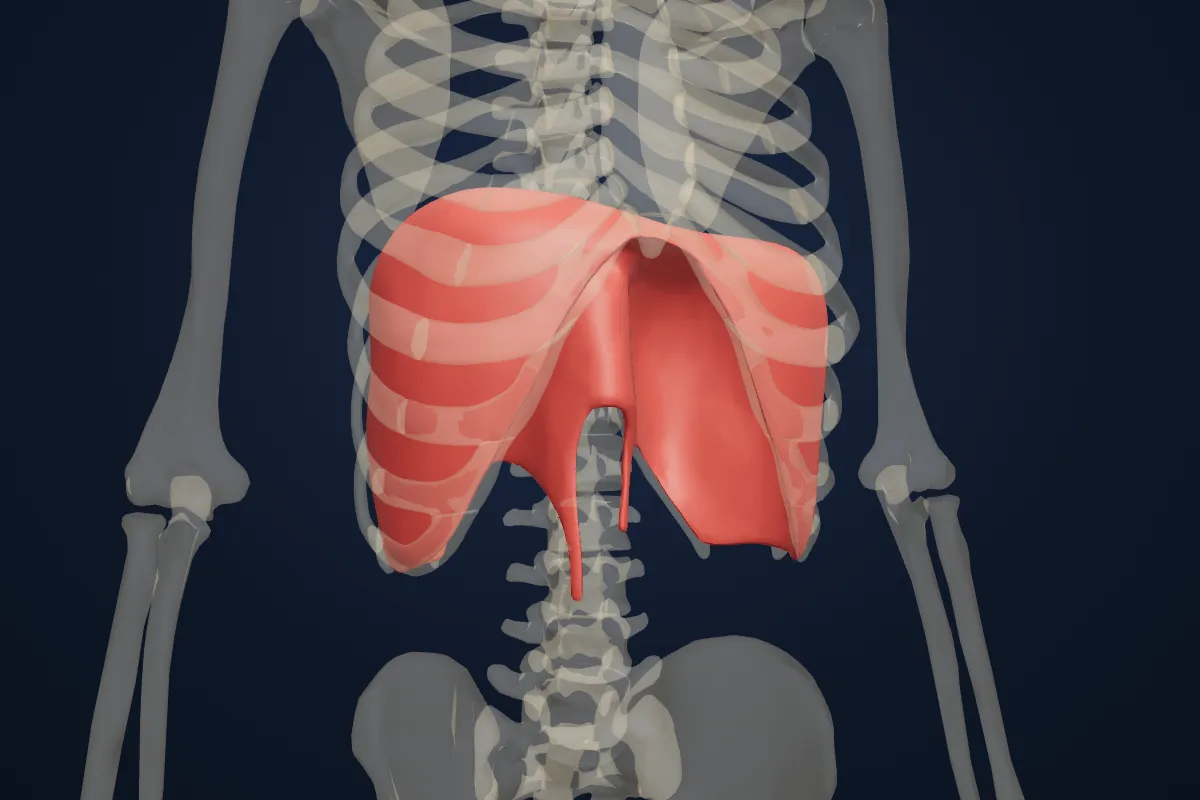
Origin
- Sternal part: back of the xiphoid process.
- Costal part: inner surfaces of the lower six costal cartilages and ribs.
- Lumbar part: the crura (from the bodies of L1–L3) and the medial and lateral arcuate ligaments.
Insertion
- Central tendon.
Innervation
- Nerve: Phrenic nerve (motor); peripheral parts also receive sensory fibres from the lower intercostal nerves
- Nerve roots: C3, C4, C5 Sources differ: Segmental (root) levels differ slightly between textbooks; the commonly cited levels are shown.
Actions
- Contracts and descends to draw air into the lungs (inspiration).
Secondary actions
- Raises intra-abdominal pressure with the abdominal muscles (lifting, coughing); contributes to trunk stability.
Relations
- The crura are attached close to the psoas major and quadratus lumborum via the arcuate ligaments.
- Diaphragmatic irritation can refer pain to the shoulder tip (C4).
Associated injuries and conditions
Conditions: referred shoulder-tip pain from diaphragmatic irritation; breathing pattern disorders.
MSK Map can also show a grade 1, 2 or 3 strain of this muscle in the app.
Related structures
- Psoas major – Its medial arcuate ligament arches over psoas
- Quadratus lumborum muscle – Its lateral arcuate ligament arches over QL
- Transversus abdominis muscle – Interdigitates with it at the lower ribs
References
- Standring S (ed). Gray’s Anatomy: The Anatomical Basis of Clinical Practice. 42nd ed. Elsevier; 2020. Section 6: Thorax; Section 8: Abdomen and pelvis
- Moore KL, Dalley AF, Agur AMR. Clinically Oriented Anatomy. 9th ed. Wolters Kluwer; 2023. Chapter 4: Thorax; Chapter 5: Abdomen
Clinically reviewed and signed off by Arun Gray BSc MSc MSST on 23 November 2026.